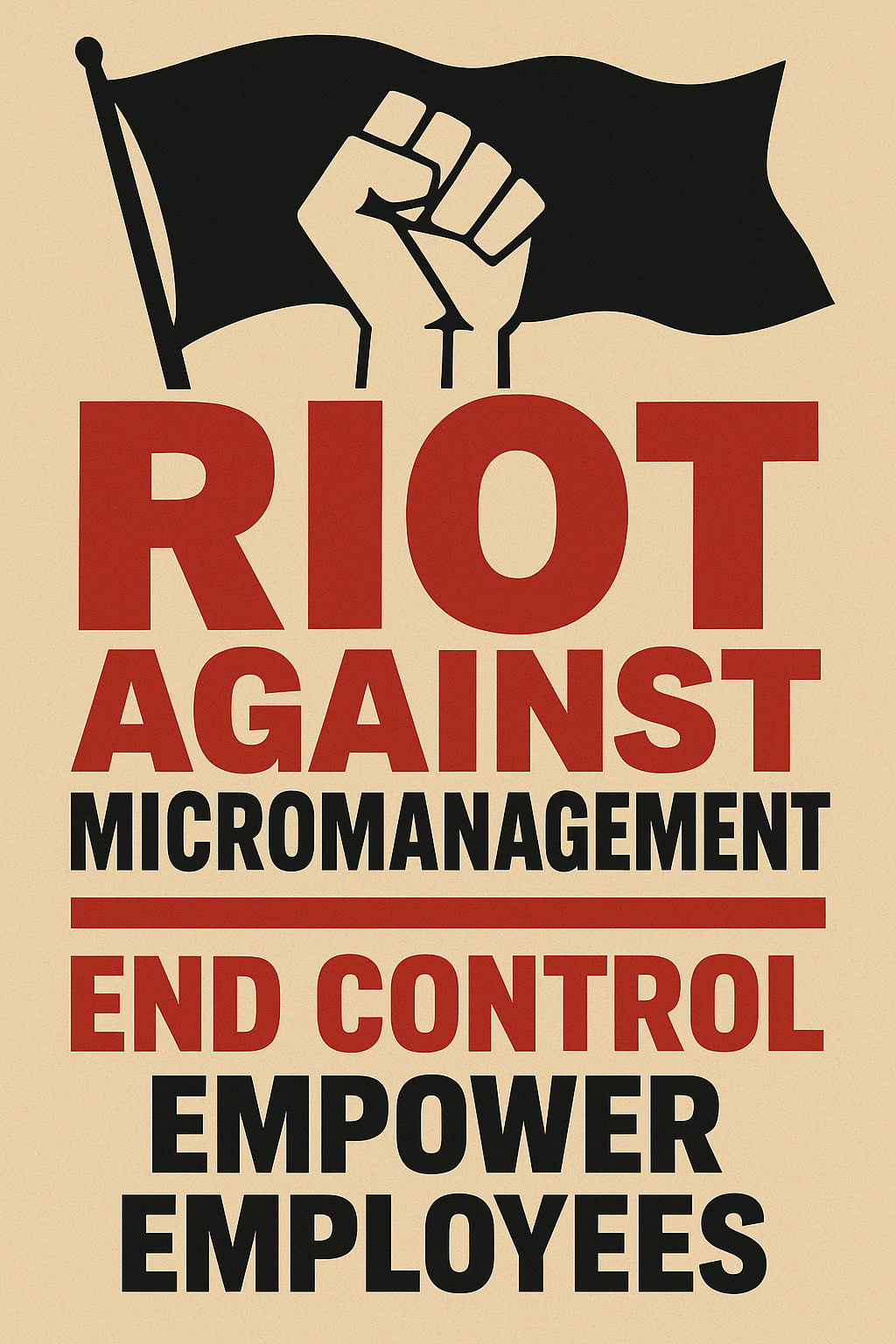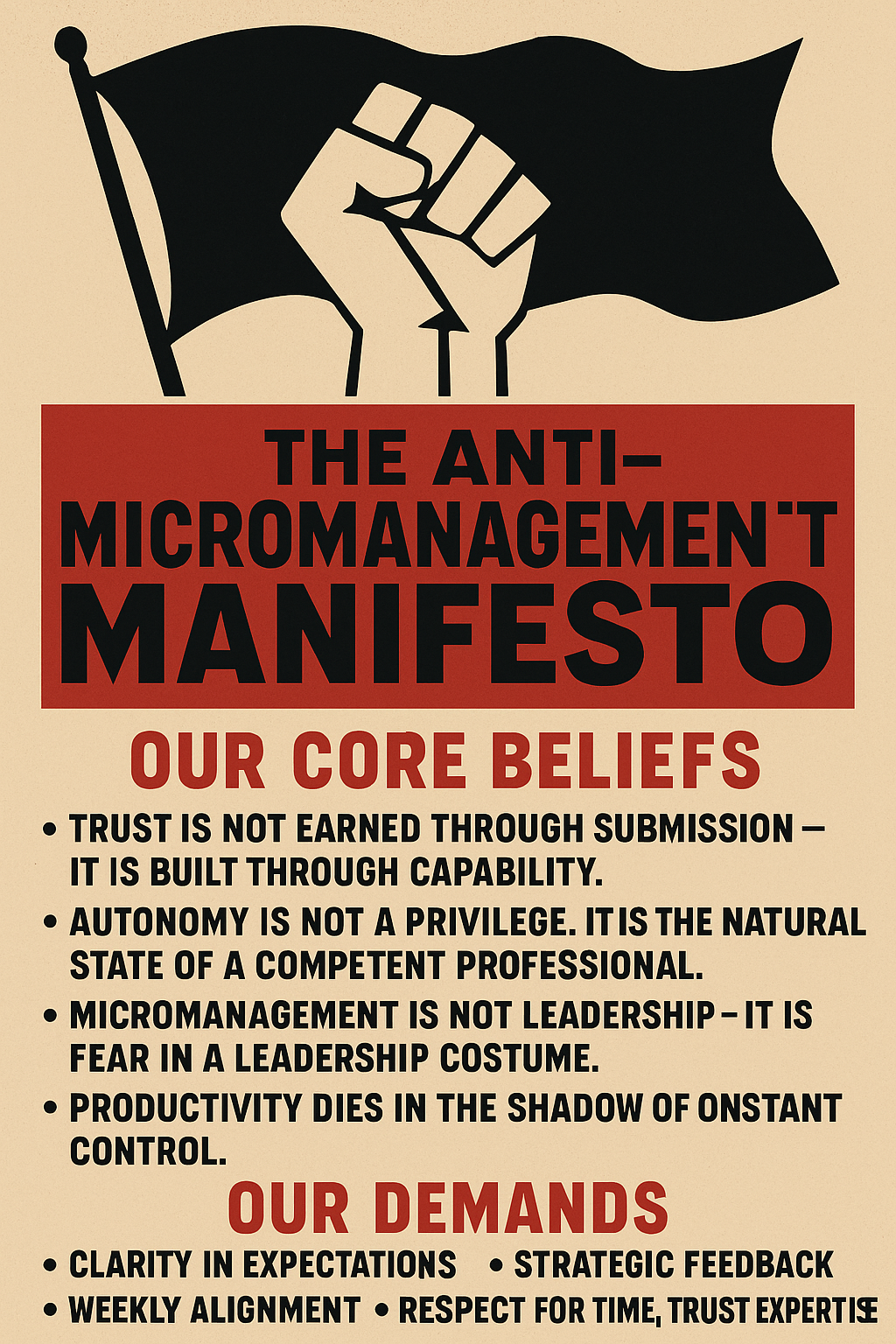
📣 The Manifesto of the Micromanaged
“We are not your puppets. We are professionals.”
✊ We, the micromanaged masses, declare the following truths to be self-evident:
That autonomy is not earned by surviving anxiety, but by being trusted from the start.
That constant check-ins are not support—they are surveillance with a friendly emoji.
That productivity is measured in outcomes, not how quickly we reply to Slack at 9:04 a.m.
That asking for space is not defiance—it is the natural cry of a caged creative.
💥 We reject:
The tyranny of the CC’d email.
The weaponization of "just checking in.”
The soul-draining dance of “let me know once you’ve done step one, so I can tell you to do step two.”
The illusion that hovering = help.
🧠 We believe:
Trust is the real performance review.
Ownership creates excellence—not oversight.
When you give us room to think, we build things that matter.
Autonomy isn’t chaos—it’s leadership, distributed.
📜 Therefore, we vow:
To communicate clearly—not constantly.
To set boundaries without apology.
To document nonsense like historians of dysfunction.
To reclaim time, energy, and peace of mind one ignored Slack at a time.
⚠️ We are not rebelling for the sake of rebellion.
We are rebelling because we care.
We care enough to want better.
Better leadership.
Better workplaces.
Better lives.
Signed,
The Chronically Monitored
The Slack-Worn
The Over-Explained
The Almost-Broken
…And the ones who refuse to be.
🛠️ The Micromanagement Resistance Handbook 🛠️
Brought to you by fed-up employees everywhere.
Survive. Subvert. Reclaim your time.
☠️ Chapter 1: Know Thy Enemy
The Micromanager:
Craves control like a dragon hoards gold.
Obsessed with details, suspicious of independence.
Measures productivity by your immediate responsiveness—not results.
Common Phrases:
“Can you CC me on that?”
“Just checking in…”
“Where are we on that thing I assigned 2 hours ago?”
“I’ll just do it myself.”
🧠 Chapter 2: Psychological Warfare (But Make It Professional)
Operation: Over-Communicate
Objective: Preempt their control cravings.
Send updates before they ask.
Use bullet points. Look organized.
End with: “Let me know if you need anything else—I’m on top of it.”
Operation: Ask More Questions
Objective: Weaponize their need for detail.
“What’s the ideal outcome you’re picturing?”
“How would you prefer I prioritize this?”
Eventually, they’ll realize they’re the bottleneck.
🧱 Chapter 3: Build the Wall of Autonomy
Phase 1: The Soft Suggestion
“Hey, I’ve noticed I’m most productive when I can focus deeply—do you mind if I check in at set intervals instead of ongoing messages?”
Phase 2: The Trial Run
“Can we try me taking full ownership of this part for a week and debrief afterward?”
Phase 3: The Victory Lap
Follow up: “Here’s how I ran it solo. Here’s what went well. Here’s how I’ll keep improving.”
🧨 Chapter 4: Organized Resistance
You are not alone. Micromanagement thrives in isolation.
Form the Resistance Cell:
Talk to coworkers. Validate each other.
Gather recurring examples (without gossip).
Approach higher-ups (or HR) as a group with solutions:
“We think efficiency could improve with more autonomy in XYZ areas. Could we try less granular check-ins?”
🎭 Chapter 5: Jedi Mind Tricks for Ego Management
Micromanagers often just want to feel needed and important. Fine. Use that.
“Make Them the Mentor” Strategy:
“I’ve learned so much from how you manage details. I’d love to try leading this next phase with that in mind—can I get your feedback at the end instead of during?”
“Trust is the New KPI”:
“I want to build your trust so you don’t have to check in—what would help with that?”
📦 Chapter 6: The Escape Plan (Just in Case)
If it’s toxic and not changing:
Start documenting specific behaviors.
Save everything: Slack messages, emails, timestamps.
Begin a paper trail with your manager or HR.
Polish your resume, update your LinkedIn. You’re a free agent now.
🧻 Appendix: Prewritten Responses
When they Slack you for the 3rd time this hour:
“Hey! Just wrapping that up now—sending you a full update in 30 minutes.”
When they want to oversee every detail:
“Would you prefer I bring you updates after major milestones so I can stay in flow?”
When you're trying to reclaim sanity:
“Would it be helpful if I gave you a weekly overview rather than constant check-ins?”
🚩Final Words
Micromanagement thrives in silence and submission.
You don’t have to burn bridges—just rebuild the boundaries.
You’re not lazy. You’re not defiant.
You’re capable, and you deserve space to prove it.
Viva la Resistance.